


100% Real 300-740 dumps - Brilliant 300-740 Exam Questions PDF
300-740 Exam PDF [2026] Tests Free Updated Today with Correct 201 Questions
Cisco 300-740 Exam Syllabus Topics:
| Topic | Details |
|---|---|
| Topic 1 |
|
| Topic 2 |
|
| Topic 3 |
|
| Topic 4 |
|
| Topic 5 |
|
NEW QUESTION # 39
To analyze application dependencies effectively, it is important to use tools like:
- A. Firewalls logs for monitoring application traffic
- B. Non-technical assessments without data analysis
- C. Cisco Secure Workload for dynamic security policy enforcement
- D. Both A and B
Answer: D
NEW QUESTION # 40
Zero-trust network access is based on the principle of:
- A. Trusting all devices inside the network
- B. Using traditional perimeter-based security models
- C. Never verifying user or device identity
- D. Trusting no one and verifying everything
Answer: D
NEW QUESTION # 41 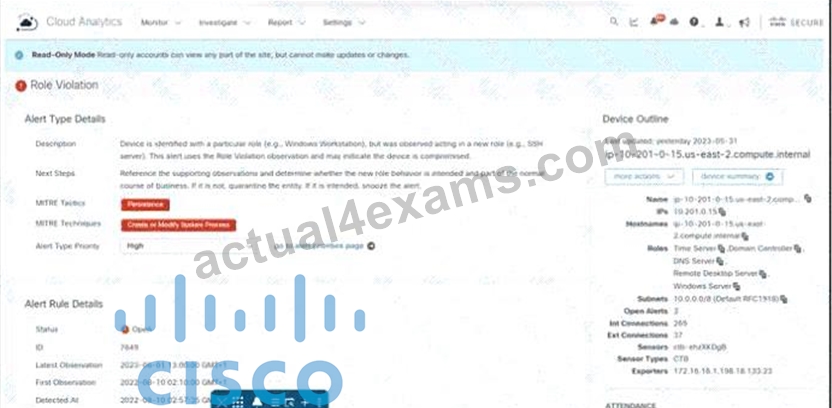
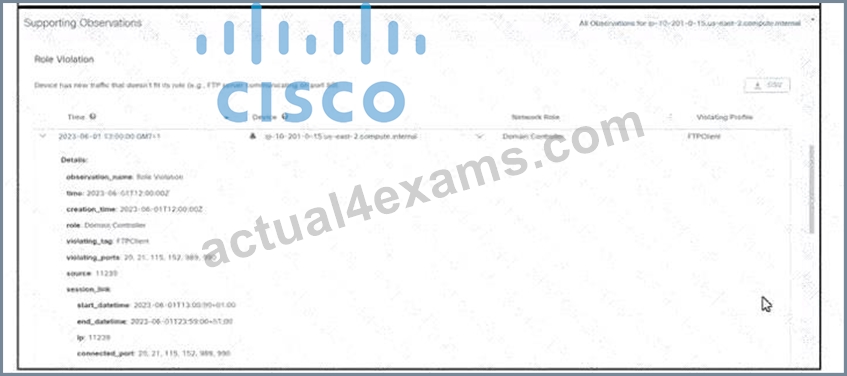
Refer to the exhibit. An engineer is troubleshooting an incident by using Cisco Secure Cloud Analytics. What is the cause of the issue?
- A. An FTP client was installed on a workstation.
- B. An attacker opened port 22 on the host.
- C. An FTP client was installed on a domain controller.
- D. An attacker installed an SSH server on the host.
Answer: C
Explanation:
The screenshot from Cisco Secure Cloud Analytics shows a Role Violation alert. According to the
"Supporting Observations" pane, the device with IP 10.201.0.15 is assigned the role of Domain Controller but has demonstrated traffic behavior matching an FTP client, connecting to ports 20, 21, 115, 152, 989, and 990.
This discrepancy triggered the alert.
Cisco SCAZT documentation emphasizes that devices acting outside their expected network roles (e.g., a domain controller acting as an FTP client) indicate potential compromise or misuse. Role-based anomaly detection is part of Visibility and Assurance mechanisms where baseline behaviors are continuously monitored and flagged when changes occur outside expected policy or operational norms.
Reference: Designing and Implementing Secure Cloud Access for Users and Endpoints (SCAZT), Section 5:
Visibility and Assurance, Pages 97-102.
NEW QUESTION # 42
Which concept is used in the Cisco SAFE key reference model?
- A. Secure Domains
- B. Threat Defense
- C. Cloud Edge
- D. Security Intelligence
Answer: A
Explanation:
The Cisco SAFE architecture uses the concept of Secure Domains as foundational blocks. These domains represent areas of the network (e.g., Branch, Data Center, Cloud, Edge) that require specific security controls.
Each domain aligns with controls across visibility, segmentation, threat protection, and identity services.
Reference: Designing and Implementing Secure Cloud Access for Users and Endpoints (SCAZT), Section 1:
Cloud Security Architecture, Pages 13-16
NEW QUESTION # 43
Cisco Secure Firewall provides advanced threat defense capabilities through:
- A. Focusing solely on internal traffic and ignoring external threats
- B. Implementing basic firewall rules that do not adapt over time
- C. Integrating with other security solutions for comprehensive protection
- D. Only allowing traffic from trusted IP addresses
Answer: C
NEW QUESTION # 44
For a web application, configuring SAML authentication means:
- A. The application can only be accessed through a specific device
- B. Users need a different password for each service
- C. The application will not support multifactor authentication
- D. Users can sign in once to access multiple applications without re-authenticating
Answer: D
NEW QUESTION # 45
The use of Cisco Secure Analytics and Logging is essential for:
- A. Combining log management with security analytics for enhanced threat detection
- B. Limiting organizational visibility into threats
- C. Reducing the effectiveness of incident response
- D. Increasing the complexity of compliance reporting
Answer: A
NEW QUESTION # 46
Which of the following are core components of the MITRE ATT&CK framework?
(Multiple Correct Answers)
- A. SSL Certificates
- B. Credential access methods
- C. Defense evasion techniques
- D. TTPs (Tactics, Techniques, and Procedures)
Answer: B,C,D
NEW QUESTION # 47
According to the MITRE ATT&CK framework, which approach should be used to mitigate exploitation risks?
- A. Consistently maintaining up-to-date antivirus software
- B. Keeping systems updated with the latest patches
- C. Performing regular data backups and testing recovery procedures
- D. Ensuring that network traffic is closely monitored and controlled
Answer: B
Explanation:
According to the MITRE ATT&CK framework and the SCAZT documentation, one of the most effective mitigation techniques against exploitation is to keep systems updated with the latest patches. Exploitation typically targets known vulnerabilities in operating systems and applications. Timely patching significantly reduces the risk of successful exploitation, especially zero-day vulnerabilities once disclosed.
Reference: Designing and Implementing Secure Cloud Access for Users and Endpoints (SCAZT), Section 6:
Threat Response, Pages 108-110; MITRE ATT&CK Enterprise Mitigation ID M1051 - Update Software.
NEW QUESTION # 48
The importance of VPN policies for remote users is to ensure:
- A. Secure and encrypted access to corporate resources from any location
- B. Remote users cannot access sensitive corporate resources
- C. The use of public Wi-Fi networks for corporate access
- D. That remote users have a slower connection to prioritize office users
Answer: A
NEW QUESTION # 49
The role of a reverse proxy in cloud security includes:
- A. Load balancing, SSL encryption, and protection from attacks
- B. Directly exposing application APIs to the public internet
- C. Simplifying the architecture by removing the need for WAF
- D. Increasing the visibility of backend servers to external threats
Answer: A
NEW QUESTION # 50
To secure user and device access, identity certificates are used for:
- A. Increasing storage capacity
- B. Encrypting email messages
- C. Speeding up the device connectivity
- D. Authenticating users and devices
Answer: D
NEW QUESTION # 51
What does the Cisco Telemetry Broker provide for telemetry data?
- A. Data mining
- B. Data analytics
- C. Data brokering
- D. Data filtering
Answer: D
Explanation:
Cisco Telemetry Broker (CTB) is designed to act as an intermediary that filters, enriches, and routes telemetry data-such as NetFlow, Syslog, and SNMP-across various tools. It optimizes resource usage by preventing overload and ensures only relevant telemetry is forwarded to appropriate analytics platforms.
The SCAZT guide (Section 5: Visibility and Assurance, Pages 93-95) describes CTB's role in applying filters and transformations to raw telemetry data to enhance visibility and reduce noise.
Reference: Designing and Implementing Secure Cloud Access for Users and Endpoints (SCAZT), Section 5, Pages 93-95
NEW QUESTION # 52 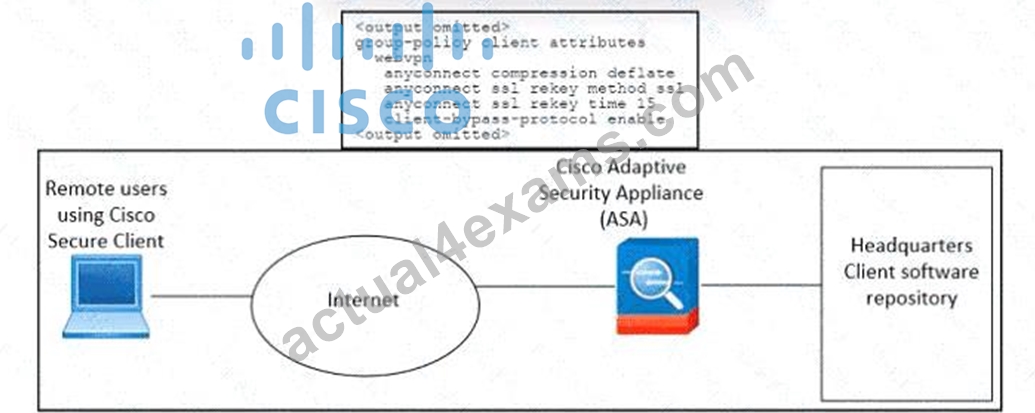
Refer to the exhibit. An engineer must configure Cisco ASA so that the Secure Client deployment is removed when the user laptop disconnects from the VPN. The indicated configuration was applied to the Cisco ASA firewall. Which command must be run to meet the requirement?
- A. client-bypass-protocol enable
- B. anyconnect firewall-rule client-interface
- C. anyconnect keep-installer none
- D. client-bypass-protocol disable
Answer: C
Explanation:
The anyconnect keep-installer none command is used to remove the Cisco Secure Client (formerly AnyConnect) from an endpoint once the VPN session ends. This is useful in temporary or kiosk-based access environments. The default behavior retains the client.
This capability is covered in SCAZT Section 2: User and Device Security (Pages 40-44), which outlines VPN session lifecycle management and Secure Client policies.
Reference: Designing and Implementing Secure Cloud Access for Users and Endpoints (SCAZT), Section 2, Pages 40-44
NEW QUESTION # 53 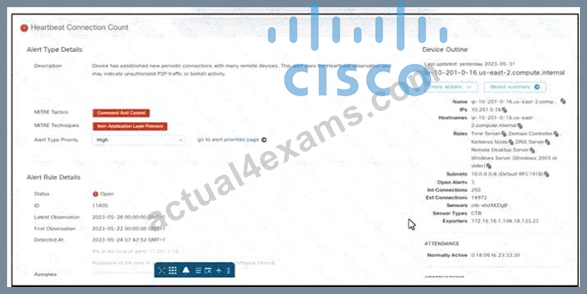
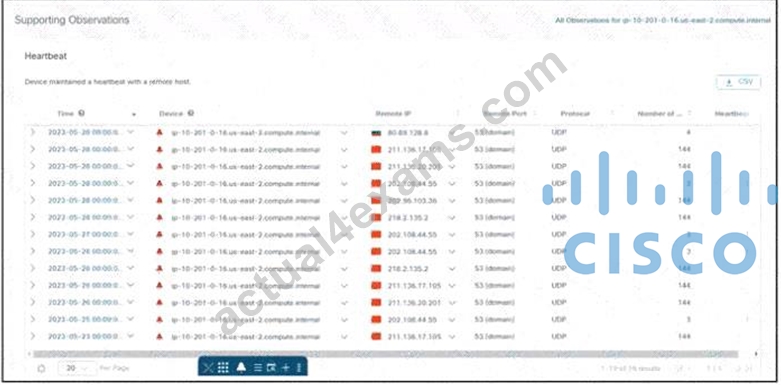
Refer to the exhibit. An engineer is investigating an unauthorized connection issue using Cisco Secure Cloud Analytics. Which two actions must be taken? (Choose two.)
- A. Inform the incident management team.
- B. Block the unwanted IP addresses on the firewall
- C. Validate the IDS logs
- D. Reinstall the host from a recent backup.
- E. Reinstall the host from scratch.
Answer: A,B
Explanation:
The Secure Cloud Analytics alert indicates suspicious heartbeat-based connections from an internal server (ip-
10-201-0-16) to multiple suspicious IPs over UDP/port 53 (DNS). This behavior suggests command-and- control (C2) activity or botnet communications.
B: Alerting the incident response (IR) team is a critical next step in escalating a verified threat as per SCAZT Section 6 (Threat Response, Pages 114-117).
D: Blocking the identified malicious IPs on perimeter firewalls or network access control devices is an appropriate containment step to disrupt communication.
Reinstallation (A/E) is premature without a full forensic investigation. Validating IDS logs (C) is useful but not immediate response-focused compared to actions B and D.
Reference: Designing and Implementing Secure Cloud Access for Users and Endpoints (SCAZT), Section 6, Pages 114-117
NEW QUESTION # 54
What is a crucial component in the MITRE ATT&CK framework?
- A. Blueprint for a secure network architecture
- B. Techniques for accessing credentials
- C. Best practices for user access management
- D. Incident response workflow
Answer: B
Explanation:
The MITRE ATT&CK framework is a globally recognized knowledge base that catalogs adversary behavior.
One of its most crucial components is its matrix of Tactics and Techniques.
"Techniques for accessing credentials" is a key example of the Techniques layer within the MITRE ATT&CK matrix.
These techniques describe how adversaries achieve tactical objectives-such as gaining access to credentials for lateral movement or privilege escalation.
In the SCAZT guide under Threat Response, organizations are advised to map telemetry and detection tools (like Cisco Secure Analytics, SecureX, and Secure Endpoint) to the MITRE ATT&CK framework to enhance visibility and accelerate threat response.
Reference: Designing and Implementing Secure Cloud Access for Users and Endpoints (SCAZT), Section 6:
Threat Response, Pages 113-116; MITRE ATT&CK Documentation.
NEW QUESTION # 55
Which component of the Cisco Security Reference Architecture focuses on identifying and analyzing threats?
- A. Security operations toolset
- B. Threat intelligence
- C. User/device security
- D. Network security
Answer: B
NEW QUESTION # 56
Web Application Firewalls (WAFs) protect against DDoS attacks by:
- A. Slowing down the application response time
- B. Inspecting incoming traffic and filtering out malicious requests
- C. Decreasing server resources
- D. Removing SSL encryption
Answer: B
NEW QUESTION # 57 
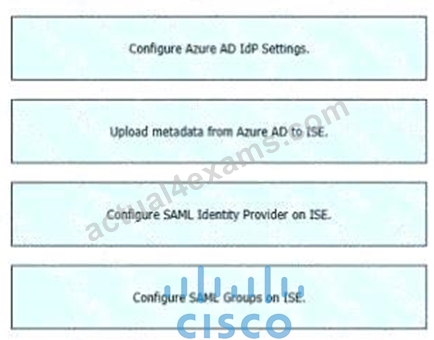
Refer to the exhibit. An engineer must configure SAML single sign-on in Cisco ISE to use Microsoft Azure AD as an identity provider. Drag and drop the steps from the left into the sequence on the right to configure Cisco ISE with SAML single sign-on.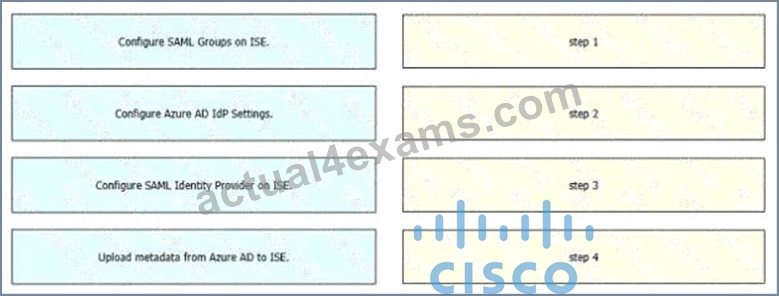
Answer:
Explanation: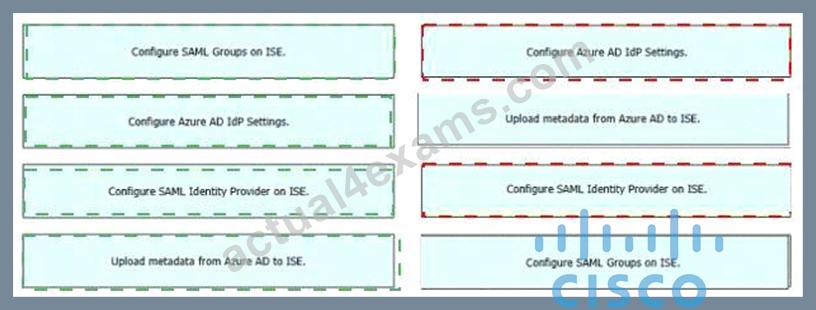
NEW QUESTION # 58
To allow users a seamless and secure login experience across multiple applications, many organizations configure _________ using an identity provider connection.
- A. firewalls
- B. antivirus software
- C. VPNs
- D. SAML/SSO
Answer: D
NEW QUESTION # 59
When determining security policies for application enforcement, which of the following is a key consideration?
- A. The color scheme of the application interface
- B. The programming language used to develop the application
- C. The popularity of the application among users
- D. The sensitivity of the data being accessed or stored by the application
Answer: D
NEW QUESTION # 60
Security services edge (SSE) combines which of the following services for enhanced security at the network edge?
- A. Secure Web Gateway (SWG)
- B. Zero Trust Network Access (ZTNA)
- C. Cloud Access Security Broker (CASB)
- D. Uninterruptible Power Supply (UPS)
Answer: A,B,C
NEW QUESTION # 61
Which of the following are purposes of URL filtering in controlling access to cloud applications?
- A. To increase internet speed
- B. To prevent access to malicious websites
- C. To block access to unauthorized web content
- D. To monitor employee productivity
Answer: B,C
NEW QUESTION # 62
Which common strategy should be used to mitigate directory traversal attacks in a cloud environment?
- A. Implement functionality validation.
- B. Use anti-cross-site request forgery tokens.
- C. Apply the principle of least privilege.
- D. Limit file system permissions.
Answer: D
Explanation:
Directory traversal attacks exploit improper file path validations to access unauthorized directories and files.
To prevent this, it is critical to restrict what areas of the file system an application or user can access. Limiting file system permissions prevents attackers from gaining access to sensitive areas even if a traversal vulnerability exists.
As explained in SCAZT Section 4 (Application and Data Security, Pages 85-87), enforcing minimal privileges and file system segmentation is a key defense against such attacks.
Reference: Designing and Implementing Secure Cloud Access for Users and Endpoints (SCAZT), Section 4, Pages 85-87
NEW QUESTION # 63
Cisco Umbrella provides visibility and assurance by:
- A. Offering DNS-layer security to prevent access to malicious domains
- B. Limiting its functionality to on-premises solutions
- C. Focusing exclusively on email security
- D. Reducing the scope of security monitoring to non-web traffic
Answer: A
NEW QUESTION # 64
......
Verified & Correct 300-740 Practice Test Reliable Source Mar 18, 2026 Updated: https://torrentpdf.actual4exams.com/300-740-real-braindumps.html