


JN0-481 Premium Exam Engine - Download Free PDF Questions
Instant Download JN0-481 Free Updated Test Dumps
NEW QUESTION # 15
You have designed your fabric in Juniper Apstra prior to deploying the network devices. Which Apstra element in the Staged tab would be used to assist the team that is installing and cabling the devices?
- A. Links table
- B. Virtual Networks table
- C. Managed Devices list
- D. Connectivity Templates
Answer: A
Explanation:
The Links table in the Staged tab shows the physical connections between the devices in the fabric. It provides information such as the source and destination device names, hostnames, serial numbers, roles, interfaces, and link status. The Links table can be used to assist the team that is installing and cabling the devices by verifying that the devices are connected correctly and that the links are operational. The Links table can also be used to troubleshoot any connectivity issues that may arise during the installation process.
NEW QUESTION # 16
Which two statements are correct about repairing a Juniper Apstra cabling map before deploying your blueprint? (Choose two.)
- A. You must manually change the cabling map to update leaf-to-generic links.
- B. Apstra can use LLDP data from the spine-to-lea! fabric devices to update the connections in the cabling map.
- C. Apstra can use LLDP data from the leaf devices to update the leaf-to-generic connections in the cabling map.
- D. You must manually change the cabling map to update spine-to-leaf fabric links.
Answer: B,C
Explanation:
The cabling map is a graphical representation of the physical connections between the devices in the data center fabric. It shows the status of the cables, interfaces, and BGP sessions for each device. You can use the cabling map to verify and repair the cabling before deploying your blueprint. Based on the web search results, we can infer the following statements:
Apstra can use LLDP data from the spine-to-leaf fabric devices to update the connections in the cabling map. This is true because Apstra can collect LLDP data from the devices using the Generic Graph Collector processor and use it to update the cabling map automatically.
LLDP is a protocol that allows devices to exchange information about their identity, capabilities, and neighbors. Apstra can use LLDP data from the leaf devices to update the leaf-to-generic connections in the cabling map. This is true because Apstra can also collect LLDP data from the leaf devices and use it to update the connections to the generic devices, such as routers, firewalls, or servers. Generic devices are devices that are not managed by Apstra but are part of the data center fabric.
You must manually change the cabling map to update spine-to-leaf fabric links. This is false because Apstra can use LLDP data to update the spine-to-leaf fabric links automatically, as explained above. However, you can also manually change the cabling map to override the Apstra-generated cabling, if needed.
You must manually change the cabling map to update leaf-to-generic links. This is false because Apstra can use LLDP data to update the leaf-to-generic links automatically, as explained above.
However, you can also manually change the cabling map to override the Apstra-generated cabling, if needed.
NEW QUESTION # 17
The 10.100.0.0/16 route is being advertised into your BGP IP fabric. ECMP load balancing has been properly enabled on all devices.
In this scenario, how many routes will the leaf device in AS 65000 receive for the 10.100.0.0/16 prefix?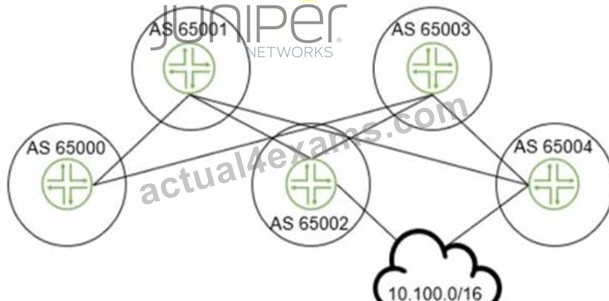
- A. 0
- B. 1
- C. 2
- D. 3
Answer: B
Explanation:
The leaf device in AS 65000 will receive three routes for the 10.100.0.0/16 prefix, one from each spine device in AS 65001, AS 65002, and AS 65003. Since ECMP load balancing is enabled, the leaf device will install all three routes in its routing table and distribute the traffic among them.
NEW QUESTION # 18
You are adding a new switch to Juniper Apstra software. The Managed Devices page shows the
"0 OS- Quarantined" status. What is the proper next step to make the device ready for use in a blueprint?
- A. Install the agent for the device.
- B. Take the device out of drain state.
- C. Take the device out of maintenance mode.
- D. Acknowledge the device.
Answer: D
Explanation:
When a new switch is added to Juniper Apstra software, it initially shows the "0 OS-Quarantined" status, which means that the device is not yet managed by Apstra and has not been assigned to any blueprint. The proper next step to make the device ready for use in a blueprint is to acknowledge the device, which is a manual action that confirms the device identity and ownership. Acknowledging the device changes its status to "OOS-Ready", which means that the device is ready to be assigned to a blueprint and deployed.
NEW QUESTION # 19
Which two statements are correct about Time Voyager? {Choose two.)
- A. Time Voyager retains the five most recent blueprint commits.
- B. Time Voyager retains all of the blueprint revisions from the last Juniper Apstra backup.
- C. Time Voyager retains the last ten blueprint commits.
- D. Time Voyager retains up to twenty-five saved revisions.
Answer: A,D
Explanation:
Time Voyager is a feature of Juniper Apstra that allows you to restore previous revisions of a blueprint, which is a logical representation of your network design and configuration. Time Voyager automatically saves the five most recent blueprint commits, which are the changes that you apply to the network. You can also manually save up to twenty-five revisions by keeping them, which prevents them from being overwritten by new commits.
NEW QUESTION # 20
What are two formats that the cabling map can be exported as? (Choose two.)
- A. HTML
- B. CSV
- C. XML
- D. JSON
Answer: B,D
NEW QUESTION # 21
Within Managed Devices in the Juniper Apstra Ul, you notice that several devices have the OOS- Quarantined status. The devices cannot be added to any blueprint. Which action would solve this problem?
- A. Install the agent, even though connectivity is established.
- B. Fix the hardware issues with the quarantined devices.
- C. Acknowledge the device.
- D. Upload a new pristine configuration.
Answer: C
Explanation:
When an agent installation is successful, devices are placed into the Out of Service Quarantined (OOS-QUARANTINED) state using the Juniper Apstra UI. This state means that the device is not yet managed by Apstra and has not been assigned to any blueprint. The device configuration at this point is called Pristine Config. To make the device ready for use in a blueprint, you need to acknowledge the device, which is a manual action that confirms the device identity and ownership. Acknowledging the device changes its status to Out of Service Ready (OOS- READY).
NEW QUESTION # 22
What is the purpose of an interface map in Juniper Apstra?
- A. An interface map specifies a connection between the interfaces of two devices.
- B. An interface map associates a logical device with a device profile.
- C. An interface map specifies the number of ports and the port speeds of a logical device
- D. An interface map specifies the connections between racks in a template.
Answer: A
Explanation:
An interface map is a configuration template that maps interfaces between logical devices and physical hardware devices (represented with device profiles) while adhering to vendor specifications. An interface map specifies a connection between the interfaces of two devices, such as a leaf and a spine, a leaf and a server, or a leaf and an external gateway. An interface map can also specify port transformations, such as breaking out a 40 GbE port into four 10 GbE ports, or disabling unused ports. An interface map can be used to achieve the intended network configuration rendering and to enable features such as LAG, ESI-LAG, or MLAG.
NEW QUESTION # 23
You are receiving cable, interface, and BGP anomalies from several devices within the data center fabric. In Juniper Apstra, how would you troubleshoot these types of errors?
- A. In the Ul, verify device connectivity by consulting the cable map.
- B. In the Ul, go to Devices and confirm that agent connectivity is fine.
- C. In the Ul, go to Time Voyager and revert to the last working version.
- D. In the Ul, access the console to the devices and review the interface states.
Answer: A
Explanation:
The cable map is a graphical representation of the physical connections between the devices in the data center fabric. It shows the status of the cables, interfaces, and BGP sessions for each device. You can use the cable map to identify and troubleshoot any cable, interface, or BGP anomalies that may occur in the fabric. You can also filter the cable map by device name, device type, device role, device state, cable state, interface state, or BGP state.
NEW QUESTION # 24
Which attribute enables Juniper Apstra to scale and manage thousands of devices with a single server instance?
- A. Apstra is installed as a cloud resource.
- B. Apstra is available as an OVA.
- C. Apstra is based on NGINX.
- D. Apstra is a distributed state system.
Answer: D
Explanation:
The attribute that enables Juniper Apstra to scale and manage thousands of devices with a single server instance is that Apstra is a distributed state system. This means that Apstra uses a graph database to store the network topology and configuration data in a distributed and replicated manner across multiple server nodes. This allows Apstra to handle large-scale networks with high performance, reliability, and availability. Apstra also uses a stateful orchestration engine that ensures the network state is always consistent with the intent of the blueprint, which is the logical representation of the network design and behavior. Apstra can automatically detect and resolve any discrepancies between the desired and actual network state, as well as handle any changes or failures in the network.
NEW QUESTION # 25
Which statement is correct about the Juniper Apstra Rendered configuration?
- A. It is dynamically tendered at commit time.
- B. It is stored in a NoSQL database and incrementally updated.
- C. It is built at commit time and stored in a MySQL database.
- D. It is rendered from the graph database and stored locally.
Answer: A
Explanation:
The Juniper Apstra Rendered configuration is the configuration that is generated from the staged blueprint and applied to the devices in the network. The Rendered configuration is dynamically rendered at commit time, which means that it is created on the fly based on the latest changes and validations in the blueprint. The Rendered configuration is not stored in any database, but it can be viewed in the Apstra UI or downloaded as a file. The Rendered configuration reflects the desired state of the network as defined by the intent of the blueprint.
NEW QUESTION # 26
You want to add a configuration that is not supported by Juniper Apstra reference architecture using a configlet.
Which two configurations would be applicable in this scenario? (Choose two.)
- A. policy configuration
- B. syslog configuration
- C. static route configuration
- D. NTP configuration
Answer: B,D
Explanation:
A configlet is a configuration template that augments Apstra's reference design with non-native device configuration. They consist of one or more generators. Each generator specifies a NOS type (config style), when to render the configuration, and CLI commands (and file name as applicable).
Some applications for configlets include the following:
- Syslog
- SNMP access policy
- TACACS / RADIUS
- Management ACLs
- Control plane policing
- NTP
- Username / password
NEW QUESTION # 27
You want to apply a configlet to a specific device using Juniper Apstra. Which two parameters would be used to accomplish this task? (Choose two.)
- A. form factor
- B. tags
- C. hostname
- D. port group
Answer: B,C
Explanation:
To apply a configlet to a specific device using Juniper Apstra, you need to specify the device's hostname and tags. The hostname is the unique identifier of the device in the Apstra system, and the tags are the labels that you can assign to the device to group it with other devices that share the same characteristics. You can use the hostname and tags to filter the devices that you want to apply the configlet to in the blueprint catalog.
NEW QUESTION # 28
When working with logical devices, you specify where each port group is connected. In this scenario, which two Juniper Apstra Ul options are available to the operator? {Choose two.)
- A. generic
- B. firewall
- C. unused
- D. router
Answer: A,C
Explanation:
When working with logical devices, you specify where each port group is connected by selecting the port group layout and the port speed and role (s) for each port group. The Juniper Apstra UI offers two options to the operator for the port group role: unused and generic.
Unused: This option means that the port group is not configured or used by Apstra. This can be useful for ports that are faulty, reserved, or not part of the data center fabric.
Generic: This option means that the port group is configured with a generic role that is not specific to any device type or function. This can be useful for ports that are used for testing, troubleshooting, or custom purposes.
NEW QUESTION # 29
When editing a device configuration to install some manual changes, which procedure should be followed?
- A. Edit the configuration on the device directly by the CLI; the changes will automatically be adjusted in the Juniper Apstra configuration
- B. Delete the device from the Juniper Apstra system, change the configuration, then re-import the device.
- C. Edit the pristine configuration of the device.
- D. Add a persistent change to a device configuration with a configlet.
Answer: D
Explanation:
A configlet is a small piece of configuration that can be applied to a device or a group of devices to make persistent changes that are not overwritten by Apstra. Configlets can be used to install manual changes that are not part of the Apstra rendered configuration, such as custom commands, scripts, or features. Configlets can be created, edited, and deleted from the Apstra GUI or CLI.
NEW QUESTION # 30
You have a virtual network that needs controlled access to other virtual networks in the same routing zone. Using the Juniper Apstra Ul. which feature would be used to accomplish this task?
- A. anti-affinity policy
- B. routing policy
- C. interface policy
- D. security policy
Answer: D
Explanation:
A security policy is the feature that would be used to accomplish the task of controlling access to other virtual networks in the same routing zone using the Juniper Apstra UI. A security policy allows you to define rules that specify which traffic is allowed or denied between different virtual networks, IP endpoints, or routing zones. A security policy can be applied to one or more virtual networks in the same routing zone, and it can use various criteria to match the traffic, such as source and destination IP addresses, protocols, ports, or tags. A security policy can also support DHCP relay, which enables the forwarding of DHCP requests from one virtual network to another.
NEW QUESTION # 31
In Juniper Apstra, which statement is correct?
- A. VMware anomaly detection requires a VMware hypervisor with exports enabled.
- B. VMware anomaly detection requires a vCenter server configured under External Systems
- C. VMware anomaly detection is on by default.
- D. VMware anomaly detection requires an Apstra server running on VMware.
Answer: B
Explanation:
VMware anomaly detection is a feature of Apstra that provides visibility and validation of the virtual network settings and the physical network settings in a VMware vSphere environment. To enable this feature, Apstra requires a connection to a vCenter server that manages the ESX/ESXi hosts and the VMs connected to the Apstra-managed leaf switches. The vCenter server must be configured under External Systems in the Apstra web interface, and the vCenter integration must be staged and committed in the blueprint. This allows Apstra to collect information about VMs, ESX/ESXi hosts, port groups, and VDS, and to flag any inconsistencies or mismatches that might affect VM connectivity.
NEW QUESTION # 32
Which two statements are correct regarding a pristine configuration in Juniper Apstra? (Choose two.)
- A. It is the configuration file placed on the device when decommissioning the device.
- B. It is the device's previously active configuration.
- C. It Is the configuration file on a device before acknowledgment in Apstra.
- D. It is the device's currently active configuration.
Answer: A,C
Explanation:
A pristine configuration in Juniper Apstra is the configuration file that is used to onboard a device into the Apstra software application. A pristine configuration contains the minimum settings that are required for the device to communicate with the Apstra server, such as the hostname, management IP address, username, password, and SSH key. A pristine configuration has the following characteristics:
It is the configuration file placed on the device when decommissioning the device. This is because when a device is decommissioned from the Apstra software application, it is reverted back to its pristine configuration, which removes all the network configuration and services that were applied by the Apstra software application. This allows the device to be reused or repurposed for another network.
It is the configuration file on a device before acknowledgment in Apstra. This is because when a device is onboarded into the Apstra software application, it is initially in the discovery state, which means that the device is discovered by the Apstra server, but not yet acknowledged by the user.
In the discovery state, the device has the pristine configuration, which can be viewed and edited by the user. Once the user acknowledges the device, the device moves to the deployed state, which means that the device is ready to receive the network configuration and services from the Apstra software application.
NEW QUESTION # 33
In Juniper Apstra. which three modes are available for devices? (Choose three.)
- A. Deploy
- B. Drain
- C. Stopped
- D. Ready
- E. Active
Answer: A,B,D
Explanation:
Juniper Apstra supports three deploy modes for devices: Deploy, Drain, and Ready. These modes determine the configuration and state of the devices in the data center fabric.
Deploy: This mode applies the full Apstra-rendered configuration to the device, according to the Apstra Reference Design. The device state becomes IS-ACTIVE and the device is ready to carry traffic in the fabric.
Drain: This mode adds a "drain" configuration to the device, which prevents any new traffic from entering the device. The device state becomes IS-READY and the device is prepared for maintenance or decommissioning.
Ready: This mode removes the Apstra-rendered configuration from the device, leaving only the basic configuration such as device hostname, interface descriptions, and port speed/breakout.
The device state becomes IS-READY and the device is not part of the fabric.
NEW QUESTION # 34
You are installing a Juniper Apstra server in your data center. You have multiple users that will be expected to configure, manage, and carry out operational tasks in your data center. You have decided to implement remote user authentication for the role-based access control of your Apstra server. In this scenario, which three methods are supported? (Choose three.)
- A. LDAP
- B. SAML
- C. RADIUS
- D. TACACS+
- E. Auth0
Answer: A,C,D
Explanation:
To implement remote user authentication for the role-based access control of your Apstra server, you can use one of the following methods: TACACS+, LDAP, or RADIUS. These are the protocols that Juniper Apstra supports to authenticate and authorize users based on roles assigned to individual users within an enterprise. You can configure the Apstra server to use one or more of these protocols as the authentication sources and specify the order of preference. You can also configure the Apstra server to use local user accounts as a fallback option if the remote authentication fails.
NEW QUESTION # 35
You connect two single-homed servers using Juniper Apstra as shown in the exhibit. You are using the ERB design blueprint with two virtual networks in a common routing zone. In this scenario, which two types of VXLAN tunnels will be automatically created by the EVPN control plane? (Choose two.)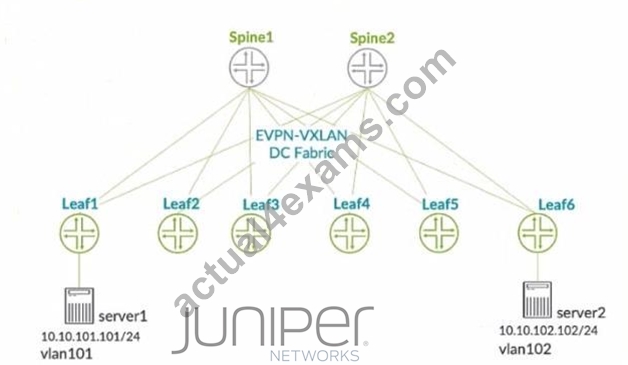
- A. EVPN signaled route Type-8 VXLAN tunnels
- B. EVPN signaled route Type-6 VXLAN tunnels
- C. EVPN signaled route Type-3 VXLAN tunnels
- D. EVPN signaled route Type-2 VXLAN tunnels
Answer: C,D
Explanation:
EVPN route Type-3 is used to advertise the IP address of the VTEP and the VNIs that it supports.
This allows the VTEPs to discover each other and form VXLAN tunnels for the VNIs that they have in common. EVPN route Type-2 is used to advertise the MAC and IP addresses of the hosts connected to the VTEPs. This allows the VTEPs to learn the MAC-to-IP bindings and the MAC-to- VTEP mappings for the hosts in the same VNI. Therefore, these two types of VXLAN tunnels will be automatically created by the EVPN control plane when using Juniper Apstra with the ERB design blueprint and two virtual networks in a common routing zone.
NEW QUESTION # 36
When an agent installation is successful, devices are placed into which state using the Juniper Apstra Ul?
- A. IS-ACTIVE
- B. OOS-QUARANTINED
- C. IS-MAINT
- D. OOS-READY
Answer: B
Explanation:
When an agent installation is successful, devices are placed into the Out of Service Quarantined (OOS-QUARANTINED) state using the Juniper Apstra UI. This state means that the device is not yet managed by Apstra and has not been assigned to any blueprint. The device configuration at this point is called Pristine Config. To make the device ready for use in a blueprint, you need to acknowledge the device, which changes its state to Out of Service Ready (OOS-READY).
NEW QUESTION # 37
Which two statements ate correct about the graph query output shown in the exhibit? (Choose two.)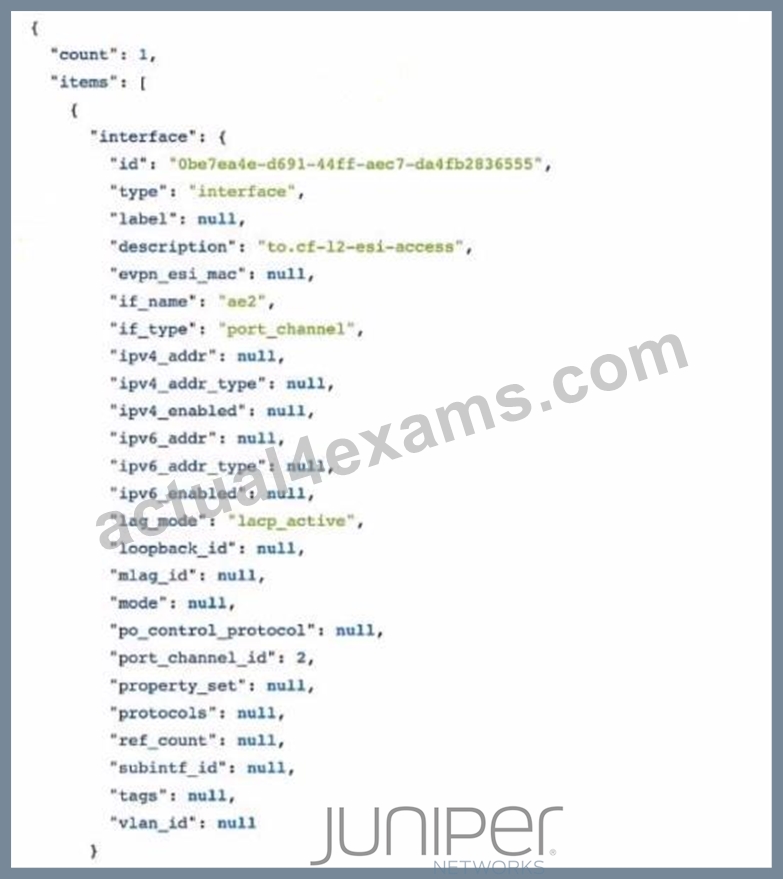
- A. The interface has an IP address assigned to it.
- B. The switch in the output is a Juniper device.
- C. The interface has tags assigned to it.
- D. The output shows a LAG connection.
Answer: B,D
Explanation:
The graph query output shown in the exhibit is a JSON representation of an interface node and its properties in the Apstra graph database. Based on the output, we can infer the following statements:
The output shows a LAG connection. This is true because the interface node has a property called lag_mode which is set to lacp_active, indicating that the interface is part of a link aggregation group (LAG) that uses the Link Aggregation Control Protocol (LACP) to negotiate the link state and parameters.
The switch in the output is a Juniper device. This is true because the interface node has a property called if_name which is set to ae, indicating that the interface name follows the Juniper naming convention for aggregated Ethernet interfaces.
The interface has an IP address assigned to it. This is false because the interface node has properties called ipv4_addr and ipv6_addr which are both set to null, indicating that the interface does not have any IPv4 or IPv6 address configured.
The interface has tags assigned to it. This is false because the interface node has a property called tags which is set to null, indicating that the interface does not have any tags associated with it.
NEW QUESTION # 38
Referring to the exhibit, which role does Device A serve in an IP fabric?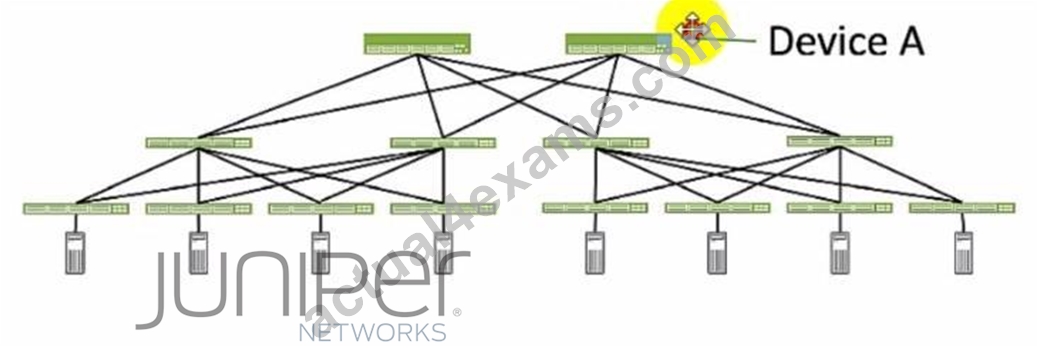
- A. server
- B. leaf
- C. super spine
- D. spine
Answer: D
Explanation:
Device A serves as a spine in an IP fabric. An IP fabric is a network architecture that uses a spine-leaf topology to provide high performance, scalability, and reliability for data center networks. A spine- leaf topology consists of two layers of devices: spine devices and leaf devices.
Spine devices are the core devices that interconnect all the leaf devices using equal-cost multipath (ECMP) routing. Leaf devices are the edge devices that connect to the servers, storage, or other network devices. In the exhibit, Device A is connected to four leaf devices using multiple links, which indicates that it is a spine device.
NEW QUESTION # 39
......
Free JN0-481 Exam Braindumps Juniper Pratice Exam: https://torrentpdf.actual4exams.com/JN0-481-real-braindumps.html