


Oct-2025 New Version CWAP-404 Certificate & Helpful Exam Dumps is Online
CWAP-404 Free Certification Exam Material with 184 Q&As
CWNP CWAP-404 Exam Topics:
| Section | Objectives |
|---|---|
Protocol Analysis - 15% | |
| Capture 802.11 frames using the appropriate methods | - Select capture devices
- Install monitor mode drivers |
| Understand and apply the common capture configuration parameters available in protocol analysis tools | - Save to disk - Packet slicing - Event triggers - Buffer options - Channels and channel widths - Capture filters - Channel scanning and dwell time |
| Analyze 802.11 frame captures to discover problems and find solutions | - Use appropriate display filters to view relevant frames and packets - Use colorization to highlight important frames and packets - Configure and display columns for analysis purposes - View frame and packet decodes while understanding the information shown and applying it to the analysis process - Use multiple adapters and channel aggregation to view captures from multiple channels - Implement protocol analyzer decryption procedures - View and use a capture’s statistical information for analysis - Use expert mode for analysis - View and understand peer maps as they relate to communications analysis |
| Utilize additional tools that capture 802.11 frames for analysis and troubleshooting | - WLAN scanners and discovery tools - Protocol capture visualization and analysis tools - Centralized monitoring, alerting, and forensic tools |
| Ensure appropriate troubleshooting methods are used with all analysis types | - Define the problem - Determine the scale of the problem - Identify probable causes - Capture and analyze the data - Observe the problem - Choose appropriate remediation steps - Document the problem and resolution |
Spectrum Analysis - 10% | |
| Capture RF spectrum data and understand the common views available in spectrum analyzers | - Install, configure, and use spectrum analysis software and hardware - Capture RF spectrum data using handheld, laptop-based, and infrastructure spectrum capture solutions - Understand and use spectrum analyzer views
|
| Analyze spectrum captures to identify relevant RF information and issues | - RF noise floor in an environment - Signal-to-Noise Ratio (SNR) for a given signal - Sources of RF interference and their locations - RF channel utilization - Non-Wi-Fi transmitters and their impact on WLAN communications - Overlapping and non-overlapping adjacent channel interference - Poor performing or faulty radios |
| Analyze spectrum captures to identify various device signatures | - Identify various 802.11 PHYs
- Identify non-802.11 devices based on RF behaviors and signatures
|
| Use centralized spectrum analysis solutions | - AP-based spectrum analysis - Sensor-based spectrum analysis |
PHY Layers and Technologies - 10% | |
| Understand and describe the functions of the PHY layer and the PHY protocol data units (PPDUs) | - DSSS (Direct Sequence Spread Spectrum) - HR/DSSS (High Rate/Direct Sequence Spread Spectrum) - OFDM (Orthogonal Frequency Division Multiplexing) - ERP (Extended Rate PHY) - HT (High Throughput) - VHT (Very High Throughput) - HE (High Efficiency)
|
| Apply the understanding of PHY technologies, including PHY headers, preambles, training fields, frame aggregation, and data rates, to captured data | |
| Identify and use PHY information provided within pseudo-headers in protocol analyzers | - Pseudo-Header formats
- Key pseudo-header content
|
| Recognize the limits of protocol analyzers to capture PHY information including NULL data packets and PHY headers | |
| Use appropriate capture devices based on proper understanding of PHY types | - Supported PHYs - Supported spatial streams |
MAC Sublayer and Functions - 25% | |
| Understand frame encapsulation and frame aggregation | - Frame aggregation (A-MSDU and A-MPDU) |
| Identify and use MAC information in captured data for analysis | - Management, Control, and Data frames - MAC frame formats and contents
- 802.11 Management frame formats
- Data and QoS Data frame formats
|
| Validate BSS configuration through protocol analysis | - Country code - Minimum basic rate - Supported rates and coding schemes - Beacon interval - WMM settings - RSN settings - HT/VHT/HE operations - Channel width - Primary channel - Hidden or non-broadcast SSIDs |
| Identify and analyze CRC error frames and retransmitted frames | |
WLAN Medium Access - 10% | |
| Understand 802.11 contention algorithms in-depth and know how they impact WLANs | - Distributed Coordination Function (DCF)
- Enhanced Distributed Channel Access (EDCA)
- Wi-Fi Multimedia (WMM)
|
NEW QUESTION # 43
Finish the statement. It is possible to distinguish between _______and ______20 MHz transmissions when looking at an FFT plot.
- A. HR/DSSS and ERP
- B. OFDM and HT
- C. ERP and VHT
- D. HT and VHT
Answer: B
Explanation:
It is possible to distinguish between OFDM 20 MHz transmissions and HT 20 MHz transmissions when looking at an FFT plot. OFDM and HT are two different modulation schemes used by
802.11 WLANs. OFDM is used by legacy 802.11a/g devices, while HT is used by newer
802.11n/ac devices. OFDM and HT have different spectral characteristics that can be observed on an FFT plot. OFDM transmissions have a flat spectrum with sharp edges, while HT transmissions have a tapered spectrum with rounded edges. This is because HT uses guard intervals and cyclic prefixes to reduce inter-symbol interference and improve performance. The other options are not correct, as they do not describe different modulation schemes or channel widths that can be distinguished on an FFT plot.
NEW QUESTION # 44
Using a portable analyzer you perform a packet capture next to a client STA and you can see that the STA is associated to a BSS. You observe the STA sending packets to the AP and the AP sending packets to the STA. Less the 2% of all packets are retransmissions. You move to capture packets by the AP and, while the retry rate is still very low, you now only see unidirectional traffic from the AP to the client. How do you explain this behavior?
- A. The portable analyzer has a lower receive sensitivity than the AP and while it can't capture the packets from the client STA, the AP can receive them OK.
- B. The STA is transmitting data using more spatial streams than the potable analyzer can support
- C. The portable analyzer is too close to the AP causing CCI, blinding the AP to the client's packets
- D. There is a transmit power mismatch between the client and the AP and while the client can hear the Aps traffic, the AP cannot hear the client.
Answer: A
Explanation:
Receive sensitivity is the minimum signal level that a receiver can detect and decode. Different devices may have different receive sensitivity levels depending on their hardware specifications and antenna configurations. In this scenario, the portable analyzer has a lower receive sensitivity than the AP, meaning that it requires a stronger signal to capture the packets from the client STA.
The AP, on the other hand, has a higher receive sensitivity and can receive the packets from the client STA even if they have a weaker signal. This explains why the portable analyzer can only see unidirectional traffic from the AP to the client when capturing near the AP.
NEW QUESTION # 45
Which one of the statements regarding the Frame Control field in an 802.11 MAC header is true?
- A. Only Control frames have a Frame Control field
- B. The Frame Control field contains subfields, and soma in 1-bit flags
- C. The Frame Control field is used to communicate the duration value
- D. The Frame Control field is always set to 0
Answer: B
Explanation:
Explanation
The statement that the Frame Control field contains subfields, and some 1-bit flags is true. The Frame Control field is a 2-byte field in the MAC header that contains information about the type, subtype, and characteristics of a frame. The Frame Control field is divided into several subfields, each with a specific function and length.
Some of these subfields are 1-bit flags, which can be set to 0 or 1 to indicate a certain condition or status. For example, the To DS and From DS subfields are 1-bit flags that indicate whether a frame is destined for or originated from the DS (Distribution System). The other statements are not true, as they do not describe the Frame Control field correctly. All types of frames (management, control, and data) have a Frame Control field, not just control frames. The Frame Control field is not used to communicate the duration value, which is a separate field in the MAC header. The Frame Control field is not always set to 0, as it varies depending on the type, subtype, and characteristics of each frame. References: [Wireless Analysis Professional Study Guide CWAP-404], Chapter 5: 802.11 MAC Sublayer, page 113-114
NEW QUESTION # 46
Which statement is true regarding the Association Identifier (AID) used in IEEE 802.11 WLANs?
- A. The client station is assigned an AID value in the 802.11 authentication response frame.
- B. The AID has a maximum value of 2007, and resides in the duration/ID field of a PS-Poll frame.
- C. The AID is used by the access point in EDCA mode to reduce duplicate transmissions when sending multicasts.
- D. The AID field is present only in Beacons frames.
- E. The AID has a maximum value of 2048, and is used to uniquely identify a wireless client station associated with an access point.
Answer: B
NEW QUESTION # 47
ABC Company's WLAN administrator is getting complaints from one user that his WLAN throughput is sluggish compared to other users in his area. The administrator takes his diagnostics laptop, which has a wireless protocol analyzer installed, to the area where the complaining user works. The administrator uses the PING utility to test connectivity from the complaining user's wireless client station to another wireless client station across the closest access point, while capturing the wireless frames.
The administrator sees what is displayed in this screenshot.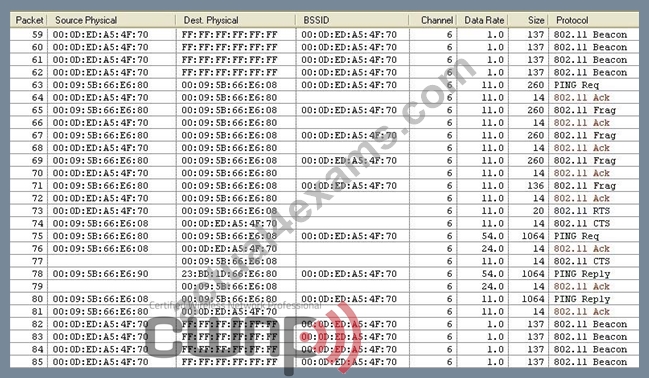
From this screenshot, which statements can you conclude to be TRUE that are related to the complaining user's throughput problem? (Choose 2)
- A. The access point and other stations are using ERP-OFDM modulation, and the complaining user's wireless client station is using HR/DSSS modulation.
- B. The complaining user's wireless client station should be using RTS/CTS as a protection mechanism, but it is not.
- C. The access point is not signaling for protection (Protection = no) in the Beacons, but it should be.
- D. The complaining user's WLAN client utilities are configured with a small fragmentation threshold.
- E. The complaining user's station is retransmitting fragments many times likely due to nearby RF interference.
Answer: A,D
NEW QUESTION # 48
You are attempting to work through a user complaint with the CWNP-recommended troubleshooting methodology.
What must be clearly identified in order to reduce the number of possible causes at step three?
- A. The problem
- B. The user name
- C. The user's IP configuration
- D. The device type
Answer: A
NEW QUESTION # 49
You have installed a new 802.11ac WLAN configured with 80 MHz channels. Users in one area are complaining about poor performance. This area is currently served by a single AP. You take a spectrum analysis capture in the poor performing area. While examining the waterfall plot you notice the airtime utilization is higher on the first 20 MHz of the 80 MHz channel when compared to the rest of the channel. What do you conclude?
- A. Non Wi-Fi interference is preventing the APs 80 MHz operation
- B. The AP is misconfigured and needs to be reconfigured to 80MHz operation
- C. The first 20 MHz is the AP's primary channel and higher airtime utilization on the primary channel is normal when an AP Is configured for 80 MHz operation
- D. RRM is enabled and has dynamically picked a 20 MHz channel
Answer: A
Explanation:
The most likely cause of higher airtime utilization on the first 20 MHz of the 80 MHz channel is non- Wi-Fi interference. Non-Wi-Fi interference can prevent an AP from using its full channel width, as it will degrade the signal quality and increase the noise floor on some parts of the channel. This will force the AP to fall back to a narrower channel width, such as 20 MHz or 40 MHz, to maintain communication with its clients. The waterfall plot can help identify non-Wi-Fi interference by showing spikes or bursts of RF energy on specific frequencies or sub-channels.
The other options are not correct, as they do not explain why only the first 20 MHz of the channel has higher airtime utilization.
NEW QUESTION # 50
As a wireless network consultant you have been called in to troubleshoot a high-priority issue for one of your customers. The customer's office is based on two floors within a multi-tenant office block. On one of these floors (floor 5) users cannot connect to the wireless network. During their own testing the customer has discovered that users can connect on floor 6 but not when they move to the floor 5. This issue is affecting all users on floor 5 and having a negative effect on productivity. To troubleshoot this issue, you perform both Spectrum and Protocol Analysis. The Spectrum Analysis shows the presence of Bluetooth signals which you have identified as coming from wireless mice. In the protocol analyzer you see the top frame on the network is Deauthentication frames. On closer investigation you see that the Deauthentication frames' source addresses match the BSSISs of your customers APs and the destination address is FF:FF:FF:FF:FF:FF:FF. What do you conclude from this troubleshooting exercise?
- A. The customers APs are misbehaving and a technical support case should be open with the vendor
- B. The customer should replace all their Bluetooth wireless mice as they are stopping the users on floor 5 from connecting to the wireless network
- C. The users on floor 5 are being subjected to a denial of service attack, as this is happening across the entire floor it is likely to be a misconfigured WIPS solution belonging to the tenants on the floor below
- D. The CCI from the APs on the floor 4 is the problem and you need to ask the tenant below to turn down their AP's Tx power
Answer: C
Explanation:
The users on floor 5 are being subjected to a denial of service attack, as this is happening across the entire floor it is likely to be a misconfigured WIPS solution belonging to the tenants on the floor below. This is because the Deauthentication frames have a source address that matches the BSSIDs of the customer's APs and a destination address that is a broadcast address (FF:FF:FF:FF:FF:FF). This indicates that someone is sending spoofed Deauthentication frames to all STAs associated with the customer's APs, causing them to disconnect from the wireless network. This is a common type of DoS attack on wireless networks, and it could be caused by a rogue device or a WIPS solution that is configured to protect the wireless network of another tenant on the floor below.
NEW QUESTION # 51
Where would you look in a packet trace file to identify the configured Minimum Basic Rate (MBR) of a BSS?
- A. In the MBR Information Element in an Association Response frame
- B. In the Minimum Basic Rate Element in a Beacon frame
- C. In the MBR Action frame
- D. Supported Rates & Extended Supported Rates elements in a Beacon frame
Answer: D
Explanation:
Explanation
The configured Minimum Basic Rate (MBR) of a BSS can be identified by looking at the Supported Rates and Extended Supported Rates elements in a Beacon frame. A Beacon frame is a type of management frame that is transmitted by an AP to advertise its presence and capabilities to potential clients. A Beacon frame contains various information elements (IEs) that provide details about the BSS configuration and operation. The Supported Rates andExtended Supported Rates IEs list the data rates that are supported by the AP for data transmission. The MBR is the lowest data rate among these supported rates that is required for all clients to join and communicate with the BSS. The MBR is usually marked with a flag bit in these IEs to indicate its mandatory status. The other options are not correct, as they do not exist or do not indicate the MBR of a BSS. References: [Wireless Analysis Professional Study Guide CWAP-404], Chapter 5: 802.11 MAC Sublayer, page 123-124
NEW QUESTION # 52
What is indicated to a QoS AP when a QoS STA sets U-APSD Flag bits to 1 in (Re) Association frames?
- A. Which user priorities require use of a TSPEC
- B. Which user priorities are mapped to access categories
- C. Which access categories are both trigger-enabled and delivery-enabled
- D. Which access categories require admission control
- E. Which access categories are scheduled
Answer: C
NEW QUESTION # 53
What is the difference between a Data frame and a QoS-Data frame?
- A. QoS Data frames include a QoS information element
- B. QoS Data frames include a DSCP control field
- C. QoS Data frames include an 802.1Q VLAN tag
- D. QoS Data frames include a QoS control field
Answer: D
Explanation:
The difference between a Data frame and a QoS-Data frame is that QoS Data frames include a QoS control field. A Data frame is a type of data frame that is used to carry user data or upper layer protocol data between STAs and APs. A QoS Data frame is a type of data frame that is used to carry user data or upper layer protocol data between STAs and APs that support QoS (Quality of Service) features. QoS features allow different types of traffic to be prioritized and handled differently according to their QoS requirements, such as delay, jitter, throughput, etc.
QoS Data frames include a QoS control field in their MAC header, which contains information such as traffic identifier (TID), queue size (TXOP), acknowledgment policy (ACK), etc., that are used for QoS purposes. The other options are not correct, as they do not describe the difference between Data and QoS Data frames.
QoS Data frames do not include a DSCP (Differentiated Services Code Point) control field, which is part of the IP header in the network layer, not the MAC header in the data link layer. QoS Data frames do not include a QoS information element (IE), which is part of some management frames that indicate QoS capabilities or parameters, not data frames. QoS Data frames do not include an
802.1Q VLAN tag, which is part of some Ethernet frames that indicate VLAN membership or priority, not wireless frames.
NEW QUESTION # 54
You are performing a multiple adapter channel aggregation capture to troubleshoot a VoIP roaming problem and would like to measure the roaming time from the last VoIP packet sent on the old AP's channel to the first VoIP packet sent on the new AP's channel. Which timing column in the packet view would measure this for you?
- A. Roaming
- B. Delta
- C. Relative
- D. Absolute
Answer: A
Explanation:
The "Roaming" timing column specifically measures the time elapsed between the last packet on the old AP's channel and the first packet on the new AP's channel, providing valuable information about the roaming time in VoIP troubleshooting scenarios.
NEW QUESTION # 55
What is the difference between a Data frame and a QoS-Data frame?
- A. QoS Data frames include a QoS information element
- B. QoS Data frames include a DSCP control field
- C. QoS Data frames include an 802.1Q VLAN tag
- D. QoS Data frames include a QoS control field
Answer: D
Explanation:
Explanation
The difference between a Data frame and a QoS-Data frame is that QoS Data frames include a QoS control field. A Data frame is a type of data frame that is used to carry user data or upper layer protocol data between STAs and APs. A QoS Data frame is a type of data frame that is used to carry user data or upper layer protocol data between STAs and APs that support QoS (Quality of Service) features. QoS features allow different types of traffic to be prioritized and handled differently according to their QoS requirements, such as delay, jitter, throughput, etc. QoS Data frames include a QoS control field in their MAC header, which contains information such as traffic identifier (TID), queue size (TXOP), acknowledgment policy (ACK), etc., that are used for QoS purposes. The other options are not correct, as they do not describe the difference between Data and QoS Data frames. QoS Data frames do not include a DSCP (Differentiated Services Code Point) control field, which is part of the IP header in the network layer, not the MAC header in the data link layer. QoS Data frames do not include a QoS information element (IE), which is part of some management frames that indicate QoS capabilities or parameters, not data frames. QoS Data frames do not include an 802.1Q VLAN tag, which is part of some Ethernet frames that indicate VLAN membership or priority, not wireless frames. References: [Wireless Analysis Professional Study Guide CWAP-404], Chapter 5: 802.11 MAC Sublayer, page 118-119
NEW QUESTION # 56
What is the default 802.11 authentication method for a STA when using Pre-RSNA?
- A. Open System
- B. PSK
- C. 4-Way Handshake
- D. Shared Key
Answer: A
Explanation:
The default 802.11 authentication method for a STA when using Pre-RSNA is Open System. This is the simplest and most common authentication method, which does not provide any security or encryption. In Open System authentication, the STA sends an Authentication Request frame to the AP, and the AP responds with an Authentication Response frame with a status code of success. After this, the STA can proceed to association with the AP.
NEW QUESTION # 57
Which one of the following is an advantage of using display filters that is not an advantage of capture-time filters?
- A. Once created they are reusable for later captures
- B. They allow for focused analysis on just the packets of interest
- C. Multiple of them can be applied simultaneously
- D. They only hide the packets from view and the filtered packets can be enabled for view later
Answer: D
Explanation:
Explanation
Display filters are applied after the capture is completed and they only hide the packets from view. The filtered packets are still present in the capture file and can be enabled for view later by changing or removing the display filter. This is an advantage over capture-time filters, which discard the packets that do not match the filter criteria and cannot be recovered later34 References:
CWAP-403 Study Guide, Chapter 2: Protocol Analysis, page 37
CWAP-403 Objectives, Section 2.3: Apply display filters
NEW QUESTION # 58
In what scenario is Open Authentication without encryption not allowed based on the 802.11 standard?
- A. When operating a BSS in the 6 GHz band
- B. When operating a BSS in a government facility
- C. When operating a BSS in FIPS mode
- D. When operating a BS5 in the CBRS band
Answer: A
Explanation:
Open Authentication without encryption is not allowed when operating a BSS in the 6 GHz band, according to the 802.11 standard. Open Authentication is a type of authentication method that does not require any credentials or security information from a STA (station) to join a BSS (Basic Service Set). Open Authentication can be used with or without encryption, depending on the configuration of the BSS and the STA. Encryption is a technique that scrambles the data frames using an algorithm and a key to prevent unauthorized access or eavesdropping. However, in the
6 GHz band, which is a newly available frequency band for WLANs, Open Authentication without encryption is prohibited by the 802.11 standard, as it poses security and interference risks for other users and services in the band. The 6 GHz band requires all WLANs to use WPA3- Personal or WPA3-Enterprise encryption methods, which are more secure and robust than previous encryption methods such as WPA2 or WEP. The other options are not correct, as they do not describe scenarios where Open Authentication without encryption is not allowed by the
802.11 standard. When operating a BSS in the CBRS band, which is another newly available frequency band for WLANs, Open Authentication without encryption is allowed, but not recommended, as it also poses security and interference risks for other users and services in the band. When operating a BSS in FIPS mode, which is a mode that complies with the Federal Information Processing Standards for cryptographic security, Open Authentication without encryption is allowed, but not compliant, as it does not meet the FIPS requirements for encryption algorithms and keys. When operating a BSS in a government facility, Open Authentication without encryption is allowed, but not advisable, as it may violate the government policies or regulations for wireless security.
NEW QUESTION # 59
You suspect an interfere may exist in a BSS that is experiencing sporadic problems. You want to identify and locate the device. The actual device identify is not known.
What tool should be used for this purpose?
- A. Protocol analyzer
- B. Spectrum analyzer
- C. Throughput tester
- D. Cable tester
Answer: B
NEW QUESTION # 60
Which parameters accurately describe the Beacon Interval field in the Beacon frame? (Choose 2)
- A. Value can range from 0 to 2007
- B. Indicates the desired time interval between TBTTs
- C. easured in time units of 1024 µs
- D. 4-octet length
- E. Indicates the exact time interval between Beacon transmissions
Answer: B,C
NEW QUESTION # 61
A manager at a retail outlet has complained that an incident occurred allowing a STA to launch an attack against another STA connected to their public Wi-Fi hotspot. He has asked you to troubleshoot the situation and verify that all possible measured are being taken to prevent this.
What configuration should you check in the AP?
- A. Inter-VAP filtering
- B. Captive portal Internet gateway
- C. DNS settings
- D. Client-to-client direct communications
Answer: D
Explanation:
Disabling client-to-client communication (also known as peer-to-peer or "AP isolation") prevents devices connected to the same wireless network from communicating directly with each other.
This helps mitigate attacks where one client station (STA) could attack another STA, such as through ARP spoofing or other local network-based attacks.
NEW QUESTION # 62
You are attempting to determine timing information within a packet capture of a WLAN protocol analyzer.
What time is used to display the time the packet was captured based on the system clock in the computer?
- A. Delta
- B. Arrival
- C. Relative
- D. Interframe
Answer: B
NEW QUESTION # 63
The To DS bit is set to 0 and the From DS is set to 1.
What best describes this 802.11 frame?
- A. A frame being transmitted in a mesh BSS
- B. A frame being transmitted directly from one client STA to another
- C. A frame being transmitted from an AP to a client STA
- D. A frame being transmitted from a client STA to an AP
Answer: C
NEW QUESTION # 64
You have installed a new 802.1 lac WLAN configured with 80 MHz channels. Users in one area are complaining about poor performance. This area is currently served by a single AP. You take a spectrum analysis capture in the poor performing area. While examining the waterfall plot you notice the airtime utilization is higher on the first 20 MHz of the 80 MHz channel when compared to the rest of the channel.
What do you conclude?
- A. The AP is misconfigured and needs to be reconfigured to 80 MHz operation
- B. The first 20 MHz is the AP's primary channel and higher airtime utilization on the primary channel is normal when an AP is configured for 80 MHz operation
- C. RRM is enabled and has dynamically picked a 20 MHz channel
- D. Non-Wi-Fi interference is preventing the APs 80 MHz operation
Answer: D
Explanation:
Explanation
The most likely cause of higher airtime utilization on the first 20 MHz of the 80 MHz channel is non-Wi-Fi interference. Non-Wi-Fi interference can prevent an AP from using its full channel width, as it will degrade the signal quality and increase the noise floor on some parts of the channel. This will force the AP to fall back to a narrower channel width, such as 20 MHz or 40 MHz, to maintain communication with its clients. The waterfall plot can help identify non-Wi-Fi interference by showing spikes or bursts of RF energy on specific frequencies or sub-channels. The other options are not correct, as they do not explain why only the first 20 MHz of the channel has higher airtime utilization. References: [Wireless Analysis Professional Study Guide], Chapter 3: Spectrum Analysis, page 74-75
NEW QUESTION # 65
......
Get The Important Preparation Guide With CWAP-404 Dumps: https://torrentpdf.actual4exams.com/CWAP-404-real-braindumps.html